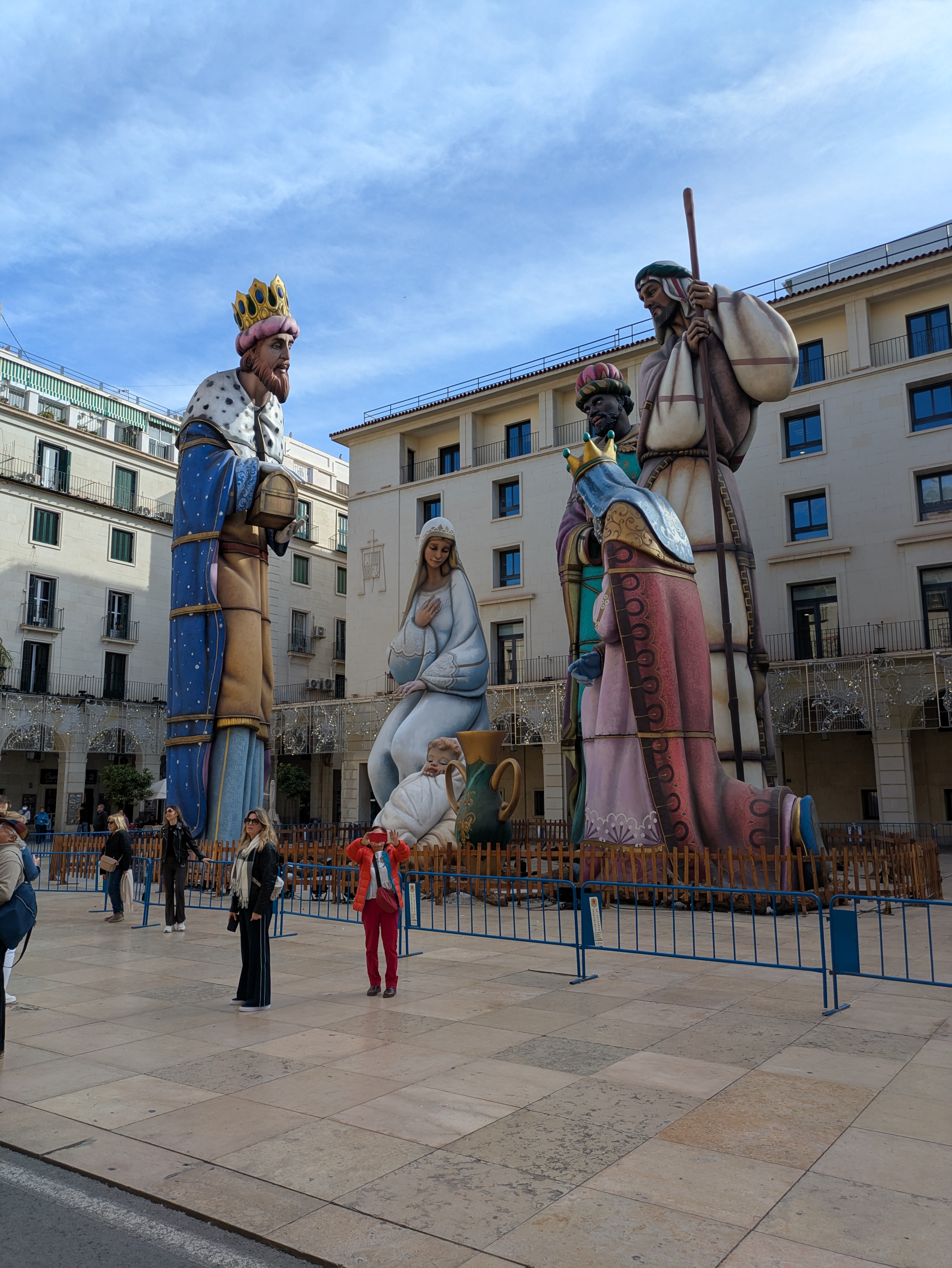
utterly random picture thread.
-
Dodgy69

- Posts: 7508
- Joined: Mon Mar 16, 2020 6:36 pm
- Location: Shrewsbury
- Has thanked: 2844 times
- Been thanked: 3495 times
-
Taipan

- Posts: 19283
- Joined: Sat Mar 14, 2020 1:48 pm
- Location: Essex Riviera!
- Has thanked: 20806 times
- Been thanked: 13610 times
Re: utterly random picture thread.
This image is a medieval manuscript illumination depicting the execution of Hugh Despenser the Younger in Hereford on November 24, 1326, 699 years ago today. The artwork comes from a manuscript of the Chronicles by Jean Froissart.
The scene illustrates the brutal medieval punishment for high treason: hanging, drawing, and quartering.
Despenser was tied to a wooden frame or sled called a hurdle and dragged by a horse through the streets to the place of execution, ensuring public humiliation. He was then hanged by the neck, but deliberately cut down while still alive and conscious. Drawing (disembowelment): While still alive, his abdomen was slit open, his genitals were cut off, and his intestines and other internal organs were removed and burned before his eyes.
Finally, he was beheaded, and his body was literally cut into four separate parts, or "quarters". The head and body parts were often parboiled to preserve them and then publicly displayed in different towns or on spikes on London Bridge as a grim warning. A large crowd of spectators watches the public execution, which was intended as a severe deterrent and a display of the monarchy's power during a time of political turmoil. Following the disembowelment and decapitation, his body was quartered, and the parts were sent to different English cities for public display.
Hugh Despenser the Younger was a controversial royal chamberlain and a favorite of King Edward II, who seized lands and made many enemies among the English nobility. He was executed after Queen Isabella and her ally Roger Mortimer successfully invaded England and overthrew the King and the Dispensers.

password protected photo album
The scene illustrates the brutal medieval punishment for high treason: hanging, drawing, and quartering.
Despenser was tied to a wooden frame or sled called a hurdle and dragged by a horse through the streets to the place of execution, ensuring public humiliation. He was then hanged by the neck, but deliberately cut down while still alive and conscious. Drawing (disembowelment): While still alive, his abdomen was slit open, his genitals were cut off, and his intestines and other internal organs were removed and burned before his eyes.
Finally, he was beheaded, and his body was literally cut into four separate parts, or "quarters". The head and body parts were often parboiled to preserve them and then publicly displayed in different towns or on spikes on London Bridge as a grim warning. A large crowd of spectators watches the public execution, which was intended as a severe deterrent and a display of the monarchy's power during a time of political turmoil. Following the disembowelment and decapitation, his body was quartered, and the parts were sent to different English cities for public display.
Hugh Despenser the Younger was a controversial royal chamberlain and a favorite of King Edward II, who seized lands and made many enemies among the English nobility. He was executed after Queen Isabella and her ally Roger Mortimer successfully invaded England and overthrew the King and the Dispensers.
password protected photo album
NC750X mpg 
-
gremlin

- Posts: 7843
- Joined: Wed Jul 08, 2020 3:12 pm
- Location: Kent (AKA God's own country)
- Has thanked: 1097 times
- Been thanked: 5861 times
Re: utterly random picture thread.
I can't believe there's nobody footing that ladder. Somebody could get hurt. 
Remember Anne Diamond!
-
Horse

- Posts: 14189
- Joined: Sun Mar 15, 2020 11:30 am
- Location: Always sunny southern England
- Has thanked: 7585 times
- Been thanked: 5912 times
Re: utterly random picture thread.
Lewis Whyld 3rd
Emmy-winning FPV drone pilot
22 years ago today I arrived to catch a helicopter with a camera in my hands and a sick feeling in my stomach. It was the final flight of Concorde, my task was to get a picture as it passed Isambard Kingdom Brunel’s Clifton suspension bridge - a 21st century photo briefly uniting engineering triumphs of the 19th and 20th centuries. One pass. One chance.
I’d studied the flight path and watched how the light moved across the landscape at that exact time of day. I walked the route and tried to imagine the shot. Everyone I spoke to said it was impossible, you can’t shoot an air to air to ground photo on a long lens, you need to shoot on a wide lens near the plane. The camera was too slow, less than 3 frames per second, so I’d have to time it precisely rather than shoot a ‘burst’. The resolution was too low for major cropping, so it needed to be framed in-camera. Concorde is brilliant white and the ground much darker which meant the exposure was tough, with little in the way of dynamic range and no test shots. Plus getting an accurate focus on Concorde and tracking it at full speed whilst timing everything was going to be… challenging.
On the day itself, everything that could go wrong did. Traffic. Weather. Second-guessing my chosen lens. But the main issue was arriving at the helicopter to find a TV cameraman already in the window seat. Sitting on the other side wasn’t an option - only one side would have the view of the bridge. The helicopter pilot thought for a moment, then casually said 7 words that would stay with me forever: ‘You can just stand on the skid’. So that’s what I did.
Now I have 1000 thoughts running through my head, all of them bad. I’m standing on the outside of a helicopter heading to 3000ft, questioning everything. Then it got cold, really cold. I’d prepared for travel in a helicopter, not the intense icy winds you get standing inches below a massive rotor blade in the open sky at altitude. It was -10C in the air with massive windchill on top. I immediately couldn’t feel my fingers or face, the only way I knew I’d pressed the shutter is if the viewfinder blacked out for a split second as the mirror moved.
Then came a radio call from the pilot - ‘we can’t hover’. It sounded bad, and in many ways it was, the air was too turbulent to hover at that height so we had to fly circuits, circles in the air but with the helicopter always facing the same direction so the bridge was in view. Which meant we’d fly forwards, then sideways, then backwards, then to the other side all whist gaining and losing copious amounts of altitude in the bumps.
I made a conscious decision at this point to think of it as a stunt - this was the closest I’d ever get to hanging off the skid of a helicopter and I was doing it at 3000ft as an airliner passed underneath. My neck hurt from my heart beat. Then Concorde came into view. The immortal words the picture editor said as I left the office came back to me, “Don’t fuck it up.”
.
Emmy-winning FPV drone pilot
22 years ago today I arrived to catch a helicopter with a camera in my hands and a sick feeling in my stomach. It was the final flight of Concorde, my task was to get a picture as it passed Isambard Kingdom Brunel’s Clifton suspension bridge - a 21st century photo briefly uniting engineering triumphs of the 19th and 20th centuries. One pass. One chance.
I’d studied the flight path and watched how the light moved across the landscape at that exact time of day. I walked the route and tried to imagine the shot. Everyone I spoke to said it was impossible, you can’t shoot an air to air to ground photo on a long lens, you need to shoot on a wide lens near the plane. The camera was too slow, less than 3 frames per second, so I’d have to time it precisely rather than shoot a ‘burst’. The resolution was too low for major cropping, so it needed to be framed in-camera. Concorde is brilliant white and the ground much darker which meant the exposure was tough, with little in the way of dynamic range and no test shots. Plus getting an accurate focus on Concorde and tracking it at full speed whilst timing everything was going to be… challenging.
On the day itself, everything that could go wrong did. Traffic. Weather. Second-guessing my chosen lens. But the main issue was arriving at the helicopter to find a TV cameraman already in the window seat. Sitting on the other side wasn’t an option - only one side would have the view of the bridge. The helicopter pilot thought for a moment, then casually said 7 words that would stay with me forever: ‘You can just stand on the skid’. So that’s what I did.
Now I have 1000 thoughts running through my head, all of them bad. I’m standing on the outside of a helicopter heading to 3000ft, questioning everything. Then it got cold, really cold. I’d prepared for travel in a helicopter, not the intense icy winds you get standing inches below a massive rotor blade in the open sky at altitude. It was -10C in the air with massive windchill on top. I immediately couldn’t feel my fingers or face, the only way I knew I’d pressed the shutter is if the viewfinder blacked out for a split second as the mirror moved.
Then came a radio call from the pilot - ‘we can’t hover’. It sounded bad, and in many ways it was, the air was too turbulent to hover at that height so we had to fly circuits, circles in the air but with the helicopter always facing the same direction so the bridge was in view. Which meant we’d fly forwards, then sideways, then backwards, then to the other side all whist gaining and losing copious amounts of altitude in the bumps.
I made a conscious decision at this point to think of it as a stunt - this was the closest I’d ever get to hanging off the skid of a helicopter and I was doing it at 3000ft as an airliner passed underneath. My neck hurt from my heart beat. Then Concorde came into view. The immortal words the picture editor said as I left the office came back to me, “Don’t fuck it up.”
.
- Screenshot_20251127-193823.png (781.95 KiB) Viewed 1832 times
Even bland can be a type of character 
-
Noggin

- Posts: 10080
- Joined: Thu Mar 19, 2020 1:46 pm
- Location: Ski Resort
- Has thanked: 19484 times
- Been thanked: 4942 times
Re: utterly random picture thread.


Life is for living. Buy the shoes. Eat the cake. Ride the bikes. Just, ride the bikes!! 
-
David
- Posts: 2431
- Joined: Tue Mar 17, 2020 8:50 am
- Location: Top 'o the Worle
- Has thanked: 222 times
- Been thanked: 788 times
Re: utterly random picture thread.
I got a brilliant view that day, on my roof with my son fixing the chimney. Earlier I had wound Penny up, telling that it wouldnt be long as the helicopter was putting the cones out. She actually stood outside telling me she couldnt see the cones.Horse wrote: Thu Nov 27, 2025 6:39 pm Lewis Whyld 3rd
Emmy-winning FPV drone pilot
22 years ago today I arrived to catch a helicopter with a camera in my hands and a sick feeling in my stomach. It was the final flight of Concorde, my task was to get a picture as it passed Isambard Kingdom Brunel’s Clifton suspension bridge - a 21st century photo briefly uniting engineering triumphs of the 19th and 20th centuries. One pass. One chance.
I’d studied the flight path and watched how the light moved across the landscape at that exact time of day. I walked the route and tried to imagine the shot. Everyone I spoke to said it was impossible, you can’t shoot an air to air to ground photo on a long lens, you need to shoot on a wide lens near the plane. The camera was too slow, less than 3 frames per second, so I’d have to time it precisely rather than shoot a ‘burst’. The resolution was too low for major cropping, so it needed to be framed in-camera. Concorde is brilliant white and the ground much darker which meant the exposure was tough, with little in the way of dynamic range and no test shots. Plus getting an accurate focus on Concorde and tracking it at full speed whilst timing everything was going to be… challenging.
On the day itself, everything that could go wrong did. Traffic. Weather. Second-guessing my chosen lens. But the main issue was arriving at the helicopter to find a TV cameraman already in the window seat. Sitting on the other side wasn’t an option - only one side would have the view of the bridge. The helicopter pilot thought for a moment, then casually said 7 words that would stay with me forever: ‘You can just stand on the skid’. So that’s what I did.
Now I have 1000 thoughts running through my head, all of them bad. I’m standing on the outside of a helicopter heading to 3000ft, questioning everything. Then it got cold, really cold. I’d prepared for travel in a helicopter, not the intense icy winds you get standing inches below a massive rotor blade in the open sky at altitude. It was -10C in the air with massive windchill on top. I immediately couldn’t feel my fingers or face, the only way I knew I’d pressed the shutter is if the viewfinder blacked out for a split second as the mirror moved.
Then came a radio call from the pilot - ‘we can’t hover’. It sounded bad, and in many ways it was, the air was too turbulent to hover at that height so we had to fly circuits, circles in the air but with the helicopter always facing the same direction so the bridge was in view. Which meant we’d fly forwards, then sideways, then backwards, then to the other side all whist gaining and losing copious amounts of altitude in the bumps.
I made a conscious decision at this point to think of it as a stunt - this was the closest I’d ever get to hanging off the skid of a helicopter and I was doing it at 3000ft as an airliner passed underneath. My neck hurt from my heart beat. Then Concorde came into view. The immortal words the picture editor said as I left the office came back to me, “Don’t fuck it up.”
.Screenshot_20251127-193823.png
Wonder if that was the chopper above.
-
Yorick
- Posts: 19881
- Joined: Sat Mar 14, 2020 8:20 pm
- Location: Paradise
- Has thanked: 12555 times
- Been thanked: 8517 times
-
Taipan
- Posts: 19283
- Joined: Sat Mar 14, 2020 1:48 pm
- Location: Essex Riviera!
- Has thanked: 20806 times
- Been thanked: 13610 times
Re: utterly random picture thread.
Early nineteenth century methods for reconstructing a nose, illustrated in the 1841 medical atlas Iconografia d’anatomia.
These illustrations come from an era when facial reconstruction was still experimental and often performed out of medical necessity rather than cosmetic choice. In the early nineteenth century, injuries, infections, and diseases like syphilis frequently caused people to lose part or all of the nose. Because the nose was central to a person’s identity and social standing, doctors devised creative and sometimes brutal techniques to rebuild it.
One common method shown here is the “forehead flap,” in which a surgeon cut a section of skin from the patient’s forehead while keeping it attached by a narrow strip of tissue to preserve blood flow. The flap was then rotated down and shaped into a new nose. Patients often wore elaborate bandages and head straps for weeks while the tissue fused, leaving visible scars that later surgeons attempted to minimize.
Procedures like these were predecessors to modern plastic surgery. They represent the moment when medicine began shifting from simply saving lives to also restoring quality of life. Though primitive by today’s standards, techniques like the forehead flap laid the foundation for reconstructive surgery as we know it.

These illustrations come from an era when facial reconstruction was still experimental and often performed out of medical necessity rather than cosmetic choice. In the early nineteenth century, injuries, infections, and diseases like syphilis frequently caused people to lose part or all of the nose. Because the nose was central to a person’s identity and social standing, doctors devised creative and sometimes brutal techniques to rebuild it.
One common method shown here is the “forehead flap,” in which a surgeon cut a section of skin from the patient’s forehead while keeping it attached by a narrow strip of tissue to preserve blood flow. The flap was then rotated down and shaped into a new nose. Patients often wore elaborate bandages and head straps for weeks while the tissue fused, leaving visible scars that later surgeons attempted to minimize.
Procedures like these were predecessors to modern plastic surgery. They represent the moment when medicine began shifting from simply saving lives to also restoring quality of life. Though primitive by today’s standards, techniques like the forehead flap laid the foundation for reconstructive surgery as we know it.
NC750X mpg
-
cheb
- Posts: 5457
- Joined: Tue Mar 17, 2020 6:51 am
- Been thanked: 2721 times
Re: utterly random picture thread.
The Royal College of Surgeons has/had a very good exhibition about WW! reconstructive surgery.
It's in Lincoln's Inn Fields, opposite the Soane museum
It's in Lincoln's Inn Fields, opposite the Soane museum
-
Taipan
- Posts: 19283
- Joined: Sat Mar 14, 2020 1:48 pm
- Location: Essex Riviera!
- Has thanked: 20806 times
- Been thanked: 13610 times

-
KungFooBob

- Posts: 17482
- Joined: Sat Mar 14, 2020 1:04 pm
- Location: The content of this post is not AI generated.
- Has thanked: 627 times
- Been thanked: 9450 times
Re: utterly random picture thread.
- Attachments
-
- 263823344_1713394148849356_1005343773966039378_n.png (237.17 KiB) Viewed 1677 times
-
Taipan
- Posts: 19283
- Joined: Sat Mar 14, 2020 1:48 pm
- Location: Essex Riviera!
- Has thanked: 20806 times
- Been thanked: 13610 times
Re: utterly random picture thread.
La Doncella The Maiden was one of three Inca children found on top of Mount Llullaillaco, a volcano sitting more than 6,700 meters above sea level on la the border between Argentina and Chile. The otherby two were a younger girl called La Niña del Rayo (the ild Lightning Girl) and a little boy known as El Niño. All three were discovered in 1999 by a team of people. archaeologists led by Johan Reinhard. Because the mountain was so cold and dry, their bodies were preserved almost perfectly like time just stopped for them.
These children were part of an ancient Inca ritual called "Capacocha." It was one of the highest honors in their society but also one of the saddest. The Incas believed that offering pure and healthy children to by their gods could bring balance ike rain for crops hild peace after disaster. The chosen ones were usually from noble families, treated with care, dressed eople. beautifully, and taken on a long journey to the mountain. But the journey wasn't about returning home it ended in a small stone tomb, where they were left to sleep forever.
Before being placed there, La Doncella was given chicha (corn beer) and coca leaves to make her calm and sleepy. When scientists studied her body, they found traces of both in her system, proving she wase likely sedated not in pain, not afraid. The freezing air k on that mountain turned her into one of the best-preserved mummies ever found her skin, hair, and clothes almost untouched by time. Even herold expression looks peaceful, as if she's just resting.
Today, La Doncella is kept at the Museum of High Altitude Archaeology in Salta, Argentina, inside a climate-controlled capsule that mimics the icy mountain where she was found.
She's not just a scientific discovery she's a reminder of how deeply people once believed in their gods... and how a young girl became part of something much bigger than herself.

These children were part of an ancient Inca ritual called "Capacocha." It was one of the highest honors in their society but also one of the saddest. The Incas believed that offering pure and healthy children to by their gods could bring balance ike rain for crops hild peace after disaster. The chosen ones were usually from noble families, treated with care, dressed eople. beautifully, and taken on a long journey to the mountain. But the journey wasn't about returning home it ended in a small stone tomb, where they were left to sleep forever.
Before being placed there, La Doncella was given chicha (corn beer) and coca leaves to make her calm and sleepy. When scientists studied her body, they found traces of both in her system, proving she wase likely sedated not in pain, not afraid. The freezing air k on that mountain turned her into one of the best-preserved mummies ever found her skin, hair, and clothes almost untouched by time. Even herold expression looks peaceful, as if she's just resting.
Today, La Doncella is kept at the Museum of High Altitude Archaeology in Salta, Argentina, inside a climate-controlled capsule that mimics the icy mountain where she was found.
She's not just a scientific discovery she's a reminder of how deeply people once believed in their gods... and how a young girl became part of something much bigger than herself.
NC750X mpg
-
MrLongbeard

- Posts: 6337
- Joined: Sun Mar 15, 2020 2:06 pm
- Has thanked: 777 times
- Been thanked: 3208 times
Re: utterly random picture thread.
So ancient dead bodies OK for here, dead bodies from living memory not OK?
-
Taipan
- Posts: 19283
- Joined: Sat Mar 14, 2020 1:48 pm
- Location: Essex Riviera!
- Has thanked: 20806 times
- Been thanked: 13610 times

-
Taipan
- Posts: 19283
- Joined: Sat Mar 14, 2020 1:48 pm
- Location: Essex Riviera!
- Has thanked: 20806 times
- Been thanked: 13610 times

-
gremlin
- Posts: 7843
- Joined: Wed Jul 08, 2020 3:12 pm
- Location: Kent (AKA God's own country)
- Has thanked: 1097 times
- Been thanked: 5861 times
Re: utterly random picture thread.
Looking at the above, I reckon the good Mrs. Gremlin has fucked up on a number of points.
Remember Anne Diamond!
-
Noggin
- Posts: 10080
- Joined: Thu Mar 19, 2020 1:46 pm
- Location: Ski Resort
- Has thanked: 19484 times
- Been thanked: 4942 times
Re: utterly random picture thread.

Life is for living. Buy the shoes. Eat the cake. Ride the bikes. Just, ride the bikes!!
-
Horse
- Posts: 14189
- Joined: Sun Mar 15, 2020 11:30 am
- Location: Always sunny southern England
- Has thanked: 7585 times
- Been thanked: 5912 times
Re: utterly random picture thread.
- Screenshot_20251203-204445.png (726.54 KiB) Viewed 1473 times
Astrophotographer Andrew McCarthy has snapped a striking shot of a skydiving YouTuber perfectly aligned with the fiery surface of the sun. The unlikely image, dubbed "The Fall of Icarus," required meticulous planning to pull off.
Even bland can be a type of character
-
Pirahna

- Posts: 2698
- Joined: Wed Mar 25, 2020 7:31 pm
- Has thanked: 2996 times
- Been thanked: 1741 times