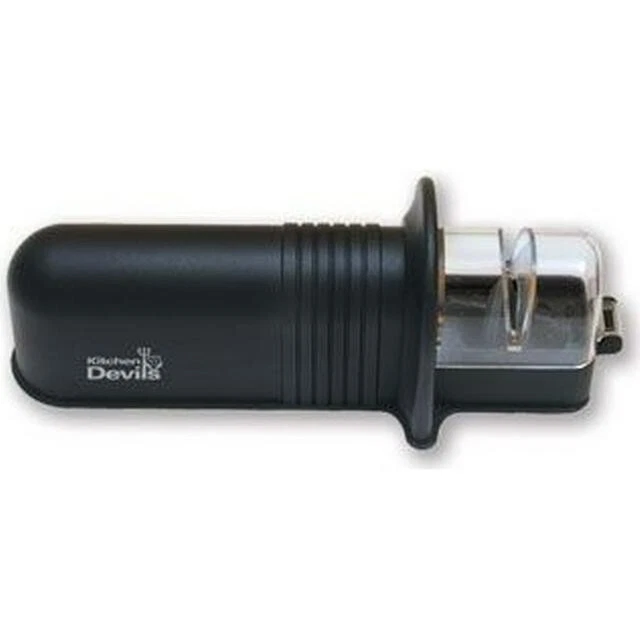
The thing about super sharp is they become, relatively, blunt quite quickly. ie you notice. So you spend even more time sharpening them. Most of the time, in the kitchen for general slicing and dicing I find a good edge is perfectly OK and lasts well. The exception is the carving knife - to reduce the sharpening faff I have two and they get sharpened along with all the others but only get used half the time between. Not that I carve much apart from roast chicken.Cousin Jack wrote: Wed Jun 04, 2025 8:41 pmI have one too. OK for a quick sharpen, but never gets a knife super sharp. That is a job for the oilstone, followed by a diamond hone.Count Steer wrote: Wed Jun 04, 2025 7:53 pmYou put water in the well so the rotating stones (coarse and fine) stay wet.
For smaller knives I take the plastic cover/guide off. I can do 12 knives in about 15 minutes.
If I ever broke it, I'd buy another.
CJ, taught to shapen planes and chisels by his Dad, a time-served carpenter.

They're using disposable stuff more and more but the ultimate in edges used to be microtome knives for cutting ultrathin, ie 4 micron, wax mounted tissue specimens for microscopy in a histology lab. Lab techs became experts in 'edge science' as much as they did in specimen cutting. They also had special glass slides of varying thicknesses that were snapped 'just so' to make an edge for leveling the mounted tissue block.
Whole rafts of learned papers were published on the benefits of the leather strop, etching an edge, blade profiles etc.



 but I'd have been gutted to lose it).